


- Designer: Shadi Torbey
- Artist: Élise Plessis
- Publisher: In Patience
- Players: 1 – 2
What will you be doing?
You will be entering a mysterious city in the depths of the Oniverse, where you must help maintain equilibrium by balancing the presence of surreal happy and sad dreams through mathematical cunning.
How Does It Play?
Urbion, like all the games in Shadi Torbey’s Oniverse series, is primarily a solitaire game, although rules for a co-operative 2 player mode are included. Also like other games in the series, it includes a base game and a series of expansions which can be mixed and matched to provide additional complexity and variety.
The mechanics of Urbion center around a central column of ‘city’ cards, alongside which you play ‘dream’ cards from your hand. These cards have various numbers on them, positive in the case of happy (‘Sognae’) cards, negative for sad (‘Incubi’). Happy cards must be played to the left of the city, sad cards to the right.
On your turn you either play a card in this way (ensuring that the symbol on the card matches one of the two symbols on the city card), or you discard a card.
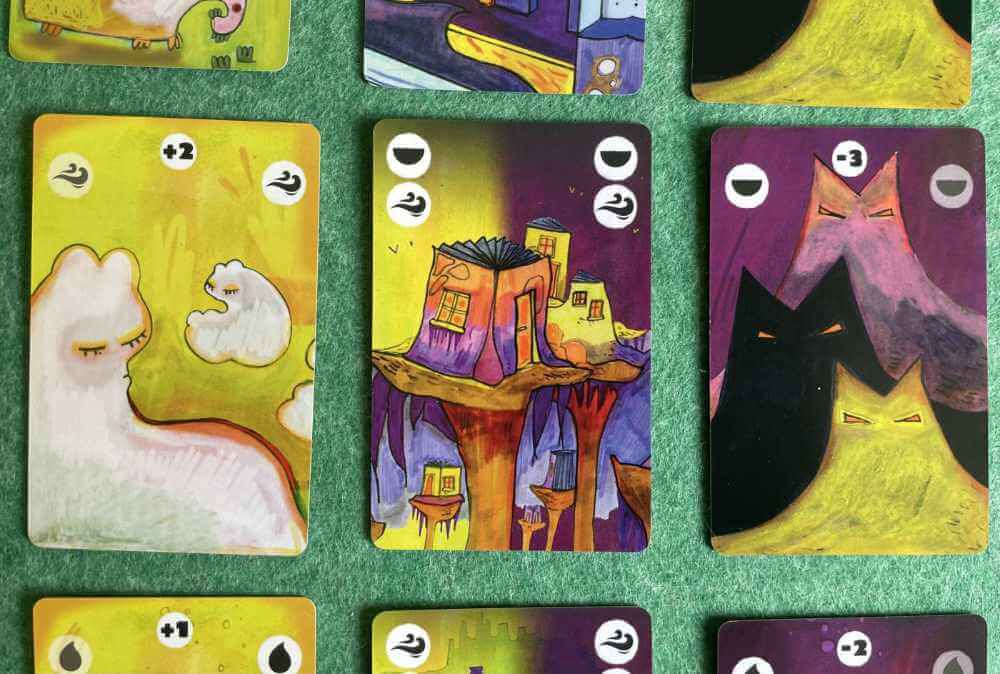
If you choose to discard a card, you can either swap any two ‘Sognae’ cards, or any two ‘Incubi’ cards, ignoring the usual symbol restrictions. Alternatively you may perform a ‘census’, where any city whose sum total of positive and negative numbers balances out to ‘zero’ can be removed from play, to be replaced by another from the city deck.
At the end of your turn, you draw another dream card, although there is a danger you will draw a ‘chaos’ card which forces you to choose from a number of actions, all of which will hamper your progress in some way.
Balance all the cities in the deck and you win the game. Run out of dream cards and you lose.
My Thoughts
I am a big fan of the Oniverse series, and Urbion is no exception. If I were to draw comparisons, I would say that the gameplay feels most similar to the first game in the series, Onirim, which is perhaps unsurprising as it was originally released just after Onirim, but hasn’t had the deluxe treatment until now.
Like Onirim, it feels like playing a traditional game of ‘patience’. I have fond childhood memories of listening to the radio while playing patience with a beaten up deck of cards. They were games where I often felt entirely at the mercy of the luck of the draw, not really appreciating the degree to which skill and experience could actually impact the game. Urbion is rather like that – sometimes you feel that the game is teetering upon playing itself as you draw yet another card you really didn’t want, and there seems to be almost no real agency. And the chaos cards – like the nightmare cards in Onirim – can feel overwhelmingly punishing.
But, as with patience, appearances are deceptive. Whilst the game is mechanically simple, and there are not many choices each turn, those choices are extremely important, and need careful consideration. This challenge, combined with the predictable rhythm of play, makes the overall experience of playing the game paradoxically both relaxing and compelling.
Additionally, the puzzle rewards perseverance. Each play will find you feeling slightly less helpless than the last as you gradually get a sense of the distribution of cards and other nuances of the game. It also helps that the game is short, so when it all goes horribly, it is quick and easy to scoop it all up and try again.
Élise Plessis’ artwork helps greatly too. It has the same quirky, otherworldly charm as the other games in the series, and the stark contrast of the dark purple and yellow cards looks great on the table. The presentation also gets the usual Oniverse treatment – I love how the insert artwork and rulebook artwork combine into a fold out landscape in this series. I’d go so far as to say that the artwork, and the delightfully surreal world it creates, are as integral to the appeal of this series as the games themselves.

I haven’t played any of the 7 expansions yet. The base game is tough and enjoyable as it is, so I will leave them aside for now, but looking through the rulebook they clearly mix the game up in all kinds of interesting ways.
Until I play those expansions I can’t really say where Urbion ranks for me amongst the other games in the series, but I can see it becoming one of my favourites. The gameplay sits somewhere between ‘Onirim’ and ‘Stellarion‘, and feels quite representative of the series as a whole, so if you aren’t already familiar with Shadi Torbey’s games and enjoy a challenging puzzle this would be a great place to start.

