

- Designer: Frédéric Henry
- Artists: Xavier Collette, Nicolas Fructus
- Publisher: Asmodee
- Players: 2 – 8
- Solo Mode: Soloable Unofficial Solo Mode
What will you be doing?
You will be creating a panoramic timeline by challenging your knowledge of science and discoveries, specifically the dates on which discoveries were made.
How does it play?
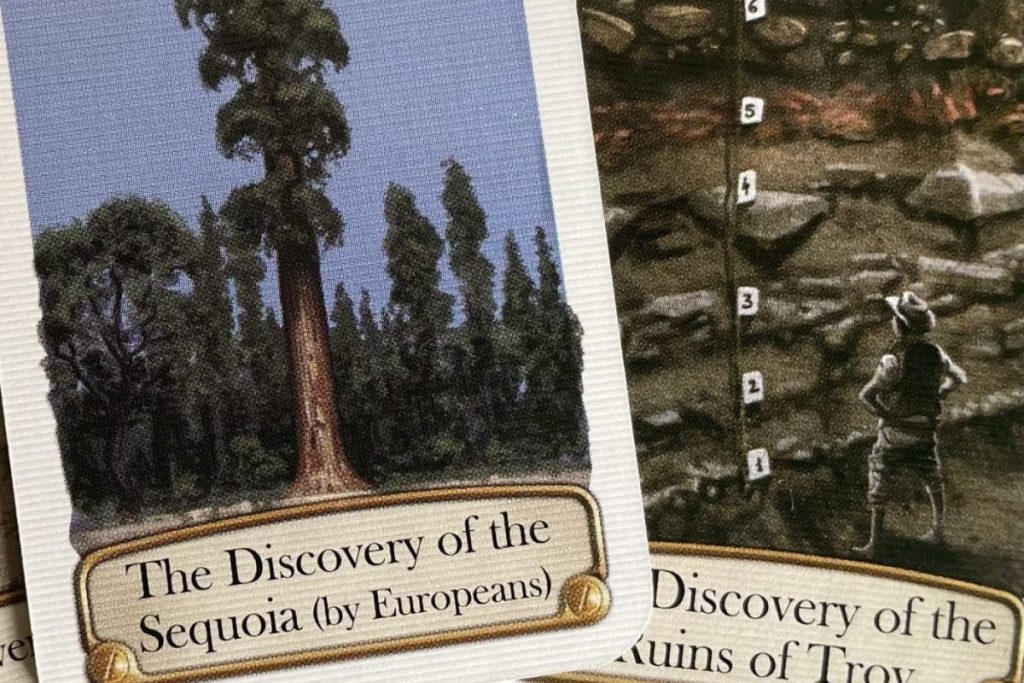
Timeline is as simple as games come. The game components consist of a single deck of cards. Each card has artwork depicting a scientific discovery, with a text description. The reverse of the card is identical to the front with one crucial difference – it also displays the date of the discovery.
A card from this deck is placed in the center of the table, with the date side showing. Each player is then dealt a hand of cards, with the dates on the reverse.

The first player places one of the cards from their hand alongside the card on the table – before the card if they think the discovery occurred before the card on the table, or after the card if they believe the date is later. Then they flip the card to see if they were right. If they were right then the card stays on the table and they are one step closer to winning. If they were wrong, the card is discarded and they draw another.

Play continues, each player placing a card either at the beginning of the emerging timeline, at the end, or somewhere in the middle, until a player plays the final card from their hand and is declared the winner.
My Thoughts
Timeline is a great little game, that everyone I have played with has found engaging. While there is only a single action to take on your turn, flipping that card is always a tense moment. Will you impress everyone that you knew that a discovery happened in the tiny window between 1945 and 1949? Or will you turn out to be decades off the mark?
There are also some real ‘wow’ moments, like when you collectively discover that what you all assumed was a modern discovery was actually made by the Ancient Babylonians. It sits alongside games like Trivial Pursuit in that it is guaranteed to promote conversation while you play, and give everyone a sense that they are learning something new.
Any concerns about replayability are I think unfounded. It is a very big deck of cards, and you don’t usually make your way through even half of it. And unless you play weekly, you are unlikely to remember any of the dates for cards you have seen before.
I think several things set this game apart from other knowledge-based games games like Trivial Pursuit. Firstly, precise recall of facts is not necessary. Unless you are unlucky enough to have a date that falls between two similar dates on the table, an approximate idea of the date is all that is needed, and you can even take a wild guess and still have a chance. I have never seen a player totally dominate the game through their encyclopedic knowledge.
And speaking of encyclopedias, the subdued tones of the painterly illustrations are very reminiscent of the encyclopedias and science magazines I grew up with in the 1970s and 80s, and as the panorama grows across the course of the game you really do get a visual representation of history unfolding that is very pleasing. It is this evocative panorama that elevates the game from a mildly educational exercise to something that I enjoy returning to again and again.
Solo Mode
Timelines does not have an official solo mode, but I have created one which you can find on this blog.


