
- Designer: Shadi Torbey
- Artist: Élise Plessis
- Publisher: In Patience
- Players: 1 – 2
I am a big fan of the Oniverse series of games. Despite there being some common threads mechanically that run through many of them, they are all distinctive and offer their own unique puzzle, none more so than Castellion, which is the only tile laying game in the series.
I love tile laying games (Carcassonne remains one of my favourite games of all time), and Castellion is no exception.
The rules are simple. You draw tiles randomly and place them in a 6 x 6 ‘castle’, building upwards from a foundation. The tiles feature two different aspects – a creature in one of four different colours, and a shape of 3 different types. The aim is to arrange the colours in a series of rows, columns and squares as defined by a sequence of ‘ordeal’ cards, with a couple of restrictions, most notably that tiles with the same shape cannot be placed adjacent to one another.
The game ends when you complete all of the ordeals or alternatively a prescribed number of ‘traitor’ tiles have been drawn, in which case you lose.

That is essentially the rules of the base game, but there are two other levels to the game which introduce more elements. Most notably, in these levels, when you choose to discard rather than place a card, you can trigger a special power, depending on the colour of the creature. This allows you to manipulate the board state in ways that break the normal rules, such as swapping adjacent tiles irrespective of shape, which becomes essential to win the harder ordeals.
Additionally, the traitor tiles operate similarly to the ‘nightmare’ cards in Onirim or ‘chaos’ cards in ‘Urbion’. That is, when drawn, bad things happen (in this case you are simply one step closer to losing) unless you do something that undoes your hard work. In Onirim that might mean giving up precious key cards, in Castellion it means removing tiles from your castle. Interestingly though, rather like the ‘chaos’ cards in Urbion, the traitor cards can sometimes be used to your advantage, as they can be a chance to remove tiles that are actually hindering your efforts.
Like Sylvion, the additional mechanics introduced in the ‘full’ game enrich the game tremendously, to such an extent that the base game can’t really be considered any more than a tutorial.
The full game however is a challenging and satisfying puzzle. It takes a few games for the basic strategies to click, but when they do the game rewards skilful play, though as with all of these games the luck of the draw certainly plays an important role.
The game is quick to set up, has a small footprint and a short play time. Above all, the game is fun. The powers triggered by the discarding of the tiles are powerful, and you can manipulate the board state in ways that give you a real sense of achievement.

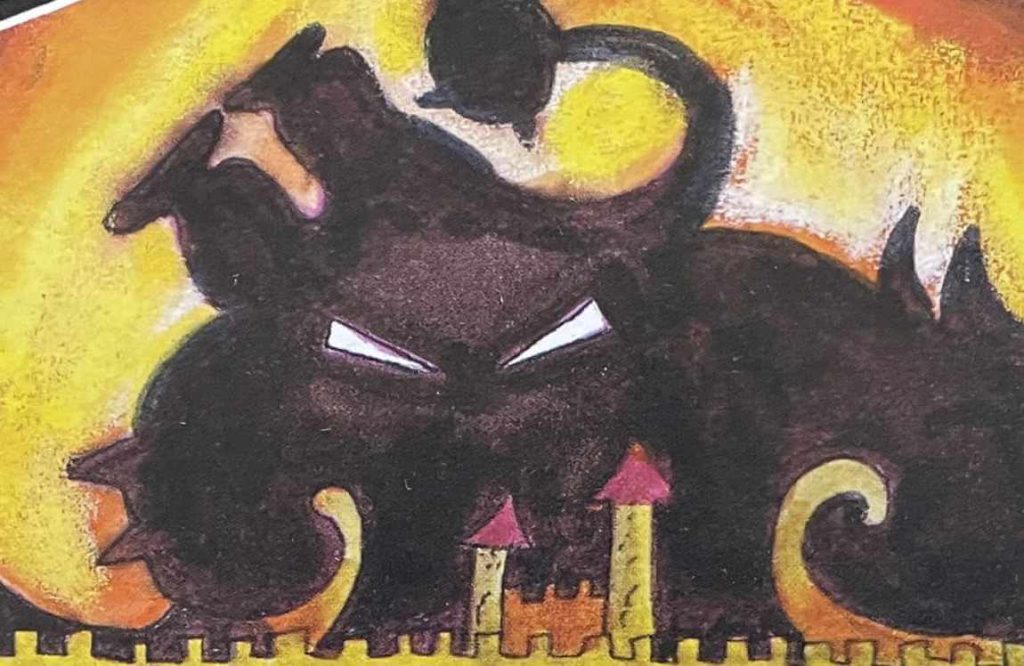
As with all the games in the Oniverse series, Élise Plessis’ artwork is full of charm and character, and the game comes with expansions to mix up the gameplay. Castellion has far fewer expansions than most of the other games in the series, though that isn’t really to its detriment, as the base game is so replayable.
In fact Castellion is possibly my favourite game in the Oniverse series. I highly recommend it.