
- Designer: Dirk Henn
- Artist: Patrick Rennwanz, Claus Stephan
- Publisher: Queen Games
- Players: 3 – 5
- Solo Mode: Soloable unofficial solo mode currently in development!
What will you be doing?
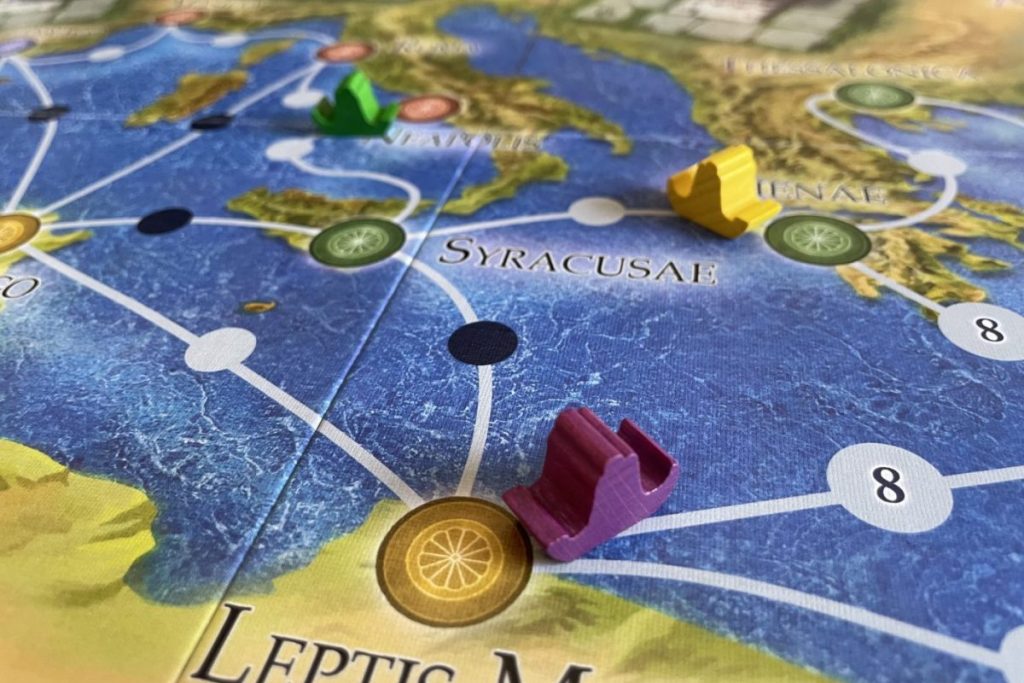
You will be Roman traders, charting a trading route across the Mediterranean, then setting out across the sea, calling on Neptun’s favour as you unfurl your sails beneath the blazing sun.
How does it play?
The game is split into 3 rounds, with each round consisting of two phases. The first phase sees players choosing a set of 3 cards from one of 5 available. Most sets are initially face down. Players can choose any face up set, or reveal the next face down set – though if they do they are committed to taking that set, or revealing the next. This might reveal a better set, but also leaves more face up options for your opponents.
Each set consists of a port card, a goods card, and a sailing card. When you select a set, you place the port and goods (a ‘contract’) into 1 of 5 contract slots on your player board. You can choose any available slot, but the order you place the contracts dictates the order you must complete them, so you’ll want to chart a course that avoids travelling too far. The sailing card (which will have sailing value and a wind value on it) you add to your hand.

Once everyone has filled their contract slots, play proceeds to Phase 2, consisting of 5 turns. Each turn every player simultaneously plays a sailing card, which plays two roles. Firstly, the sum total of the wind values dictates the influence of the wind in the next turn. Secondly, your sailing value dictates how far you can move your ship (adjusted upwards or downwards by the previous turn’s combined wind numbers).
Each player then moves their ships, aiming to reach their first destination port. If they do reach it, they gain a reward based on the combination of goods and port, shown on the port card. This reward will either be gold, or progression along the region’s temple track.

This process is repeated for three rounds, with players intermittently scoring bonuses for completing all their contracts, having the most gold, being furthest along temple tracks etc, and final scoring being carried out at the end to determine the winner.
My thoughts
I’m a big fan of Dirk Henn’s ‘Alhambra’, but whereas that game is widely held in high regard, I hardly ever hear ‘Neptun’ being spoken about. Which is a shame as I consider this to be something of a hidden gem.
The game is very inviting – as with other Queen Games titles, the artwork is lovely and even adorns the back of the board and the insert. The imagery on the cards is evocative, and the map of the Mediterranean looks great on the table – once the game is set up you can’t wait to get going.
The mechanics of the game are also really unique, and the two phases of each round give the game a nice rhythm, in a way that reminds me a little of ‘For Sale’. The first phase is all preparation and second phase is competing with your rivals to carry out your plan.
The preparation phase has lots of tension. Do you take a lucrative contract on the far side of the map, hoping to plot a course that ends up there? Do you take a low paying contract, or one you are unlikely to complete, because there is a really high numbered sailing card that will help you reach your others? Do you risk revealing a face down set when it might be worse than what is there?
In the second phase there is something very satisfying (or frustrating) about seeing your plans come together (or go horribly wrong). The simultaneous reveal of cards is always fun in any game.The wind can really help or impede your progress, so judging when to play your high cards is critical. You can also hamper your opponents by deliberately slowing down the wind for turns when you won’t have to travel far yourself.
There is a fair amount of luck, but also ways to mitigate it – the game is one of lots of small decisions and gambles. It is engaging and has enough bite to be satisfying while still being accessible to anyone comfortable with light euros.
One thing to note is that there were three ‘Queenies’ (Queen Games’ name for their mini expansions) released for Neptun, and I would say that the second of those expansions is almost a ‘must have’ as it adds incentives to trade in specific goods at specific ports to gain sets of tokens. This adds a welcome layer of decision making and competition that is arguably missing from the base game.
The only other niggles are that the name of the ports on the cards could be a lot clearer, and the play time of the game is rather long for a relatively light euro, with most games tending to clock in at over 1.5 hours. Perhaps if it took half an hour less to play and had included the second expansion as part of the base game it may have gained more traction when it was released. As it is, it is still one of my favourite games to pull out with the more euro-minded members of the family when we want to sail the seas and remind ourselves of the sights and tastes of the Mediterranean countries we have all loved to visit.
Solo Mode
There is no official solo mode for Neptun, however I am currently working on an unofficial solo ruleset and will post them here when completed!