

- Designer: Matt Calkins
- Artists: Donal Hegarty, Kurt Miller
- Publisher: GMT Games
- Players: 2 – 6
- Solo Mode: unofficial solo modes available
What Will You Be Doing?
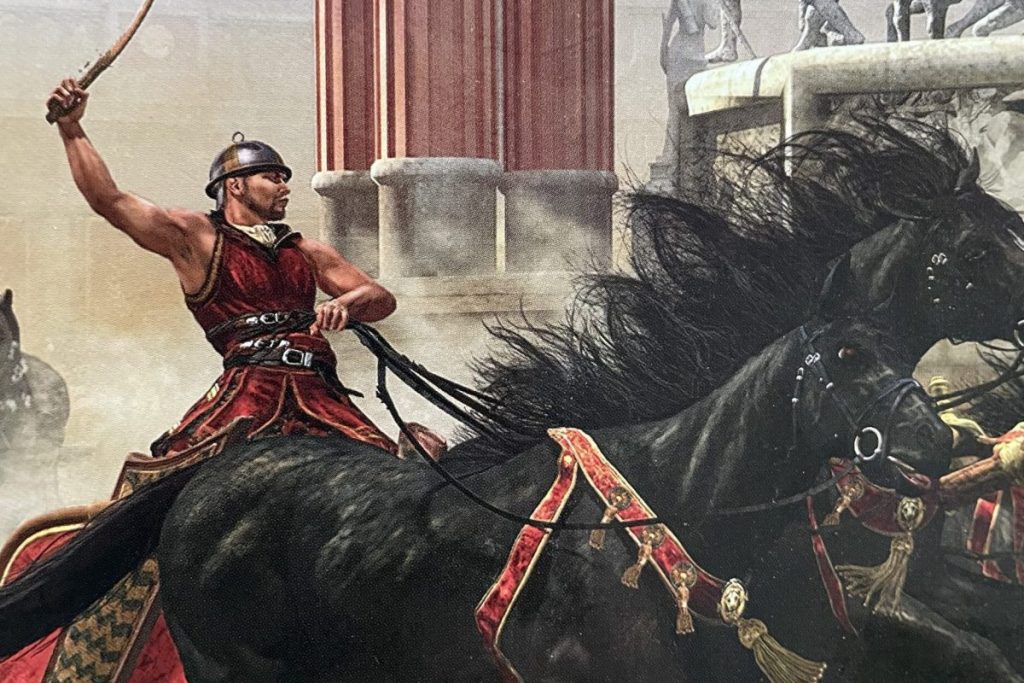
You will be racing your opponents through the dust and heat of Ancient Rome, the rattle of your chariot’s wheels drowned out by the cheering of the crowds as you attempt to impress the Emperor with your skills.
How It Plays
Charioteer is a card driven racing game. Each player has a player board that keeps track of skills progression and damage to their chariot, and has a hand of 8 cards, from which each round they simultaneously select a set of up to 3 to play. Every card in the set must contain a matching symbol (which consists of a colour and a number). The total movement points is calculated by multiplying the number on that shared symbol by the number of matching symbols on the cards (eg. 6 green ‘4’ symbols would result in 24 points).
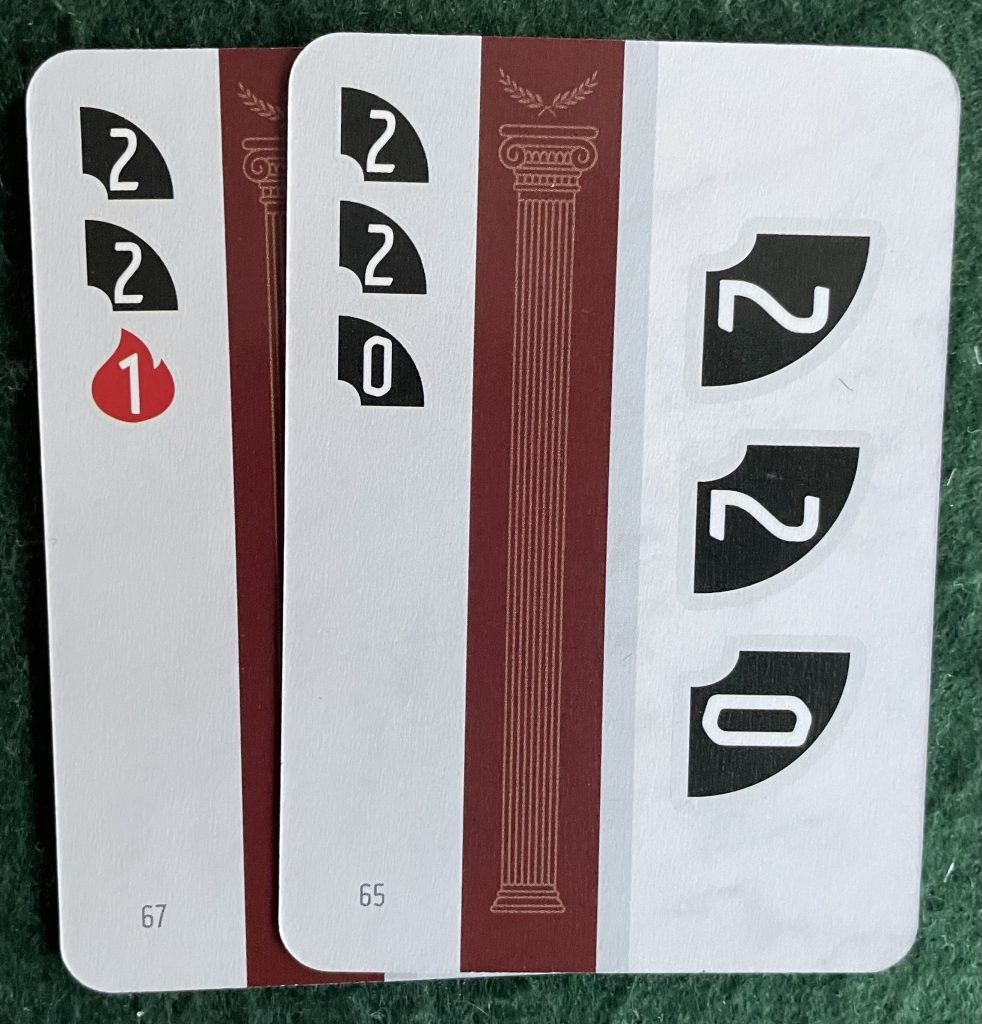
Each player then moves their charioteers around the track by the number of spaces dictated by the cards, subtracting the number of damage cubes they have. If they turn a corner, they must zig-zag between an inner and outer lane, unless they played black symbols, in which case they can ignore the outer lane, moving through the corner much faster as a result. If the player instead played yellow symbols, they can remove half of their damage cubes. If a player plays red symbols, then they get to add damage cubes to their opponents.
After making their move, players advance the colour they played on a skills track on their player board. Crossing various milestones on this track grants permanent bonuses to future plays of that colour. Additionally, if the cards they played included 6 or more of the chosen symbol, they get to take a random tile from the bag that grants them one-time powers for later use.
That, in essence is the game, though there are some additional considerations the players must make. Firstly, there are 3 crowd cards in the center of the board. All players may include the first of these as though it was part of their hand, and they also get to see the crowd cards of the next two rounds, allowing for some future planning. Additionally a die is rolled to determine the Emperor’s favour for each round – ie. which colour he wants to see played. If players play that colour they get to advance on the skill track twice.
The game ends at the end of the turn in which at least one player completes 3 laps, the winner being the player whose charioteer has finished furthest beyond the finish line.
My Thoughts
What impresses me most about Charioteer is just how well designed and finely tuned the mechanics are. It’s hard to pinpoint exactly what makes it feel so smooth, but there is something very elegant about how the mechanics play off each other, and there is fantastic flow to the rounds which really captures a sense of racing.
The game centres on the simultaneous selection of cards that provides a dilemma for the players. The obvious choice is always to move as far as you can, to outrun your opponents, and force them to spend their precious movement points overtaking you if they do catch up.
But what if that means using a card that you could play next round alongside one of the upcoming crowd cards to hurtle round the oncoming corner?
Or what if the emperor wants you to do something completely different? Missing out on an opportunity to double your skill progression is not a decision to take lightly. Maybe a slightly sub-optimal move now will pay dividends in the next lap.
It is this continual balancing act between the urge to push as fast as you can, versus preparing for potential future opportunities, that makes every turn interesting, along of course with the inherent tension in watching your opponents edge closer behind you, or worse still leave you for dust.
If I had to find fault with the gameplay, I would say that the game is a bit too long for what it is. A 4 player game can easily clock in at 2 hours. I wouldn’t say it outstays its welcome – the game is too snappy and engaging – but the game length does prevent it from hitting the table as often as it otherwise might.
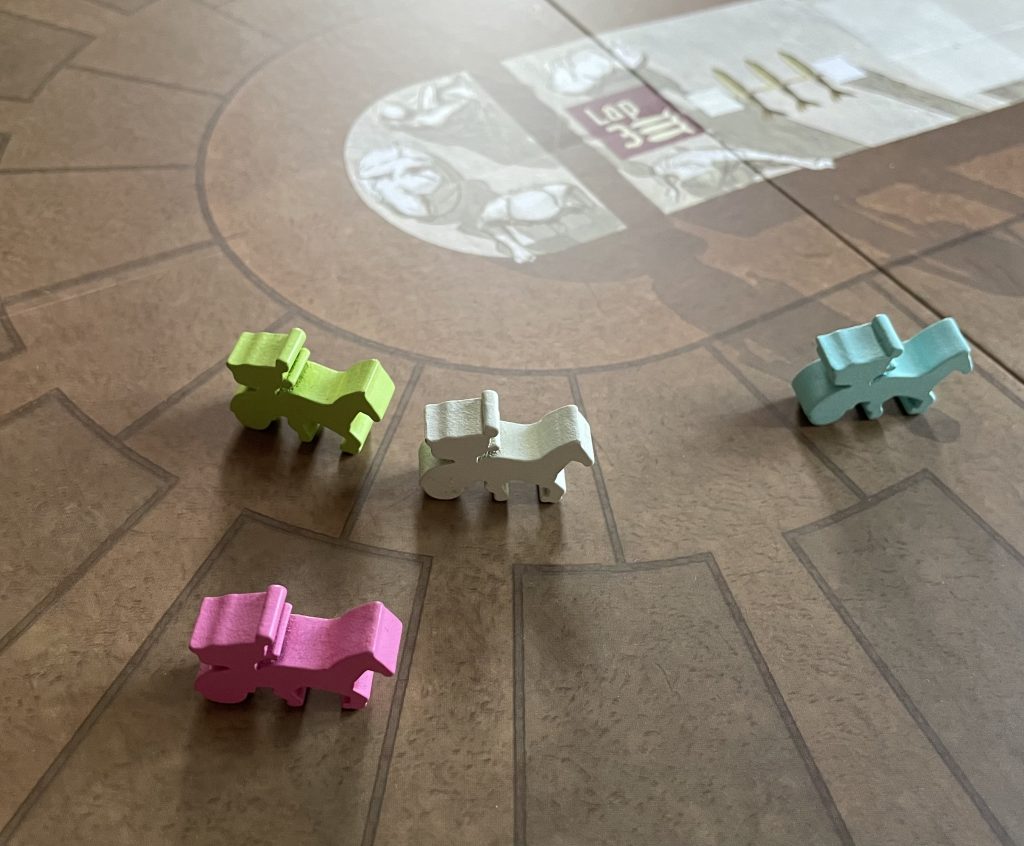
The components are mostly excellent. The chunky tiles are lovely and tactile, and whilst the board is a bit lacking in detail, the shadows are a nice touch and its size alone gives it a good table presence. However, the pastel colour schemes of the player boards, while appealing, present some usability issues – the yellow is particularly hard to read.
Minor complaints aside, Charioteer is a terrific racing game. The low complexity, fast turns, and elegant mechanics make it a real delight to play.
Solo Mode
There is no official solo mode but a couple of people have had a go at creating unofficial ones, one of which I have tried and found worked nicely, giving a decent feel of a multiplayer game with little maintenance. The rules can be found on their creator’s blog. I probably wouldn’t recommend purchasing Charioteer purely for solo play but this solo mode is definitely a quick and accessible way to enjoy the game every once in a while.

