
- Designer: Shadi Torbey
- Artist: Élise Plessis
- Publisher: In Patience
- Players: 1 – 2
Stellarion is the 7th game in Shadi Torbey’s Oniverse series of games. Every game is primarily solitaire, although a co-operative two player ruleset is also included. Every tile is illustrated by Élise Plessis.
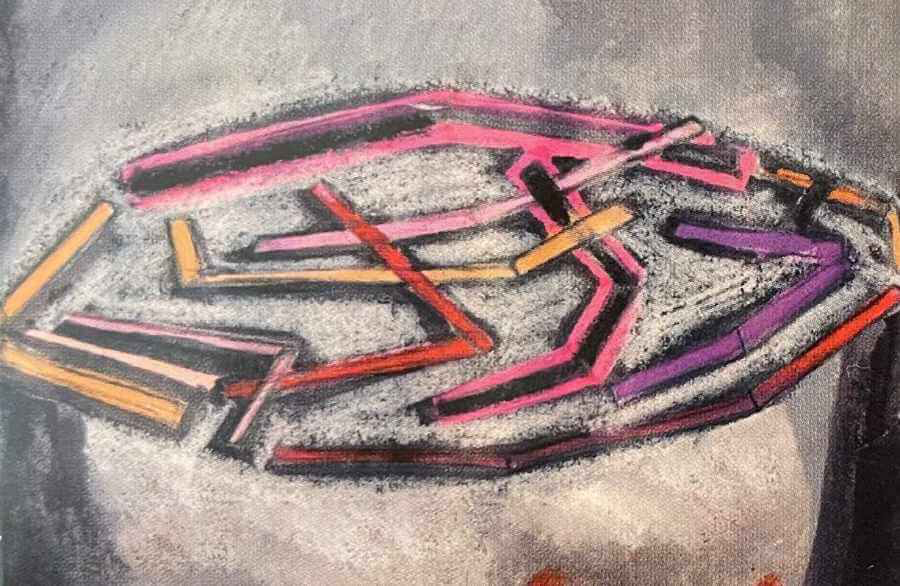
In fact, the thing you first notice with Stellarion is Élise Plessis’ artwork. Compared to other games in the series, the card designs are uncharacteristically sparse, capturing the emptiness of space, with illustrations depicting celestial objects and structures rather than the usual dreamlike creatures. I really like this clarity to the illustrations in Stellarion – it makes them distinctive yet unmistakably part of the Oniverse.
The game revolves around 8 small decks of cards. In addition to a unique deck symbol, which identifies which of the 8 decks it belongs to, each card has a Type and a Galaxy symbol. You arrange the decks in a grid and flip over the top card of each so that 8 cards are visible.
The aim of the game is to get the top cards of the decks to display a total of 4 cards with the same Galaxy symbol, in order to collect a corresponding Voyage card. You need a total of 8 Voyage cards to win.

Each round you discard two cards from the 8 on display, which must have matching Type symbols. Each of the 8 decks has its own discard pile. Depending on what the matching symbol was, you can then carry out an action, like retrieving a card from one of the discard piles and placing it on top of its deck, or searching a deck for a specific card.
These actions are crucial, and require a lot of consideration. I found it took a few games to fully understand the make-up of the decks, and what actions were most useful at any given time.
Finally you turn over the top card of any decks that are now not showing a card, such as the decks you discarded from.
Whenever you have 4 matching Galaxy symbols you can claim a Voyage card. You win if you collect all 8 cards, or lose if you are unable to discard any cards (usually once 2 or 3 decks have become exhausted).
That is essentially all there is to it, although as always the game contains a number of expansions that add additional mechanics, such as black holes.

Of all the Oniverse games, Stellarion is probably the most ‘puzzly’. There’s little of the luck of the draw that can make or break a game of Onirim or Castellion. The game gives you a lot of control of the game by providing you with multiple ways to manipulate the piles of cards in front of you. If you lose, it’s likely due to a failure to plan ahead, not an unlucky draw.
Whether that makes the game more enjoyable is a matter of preference. Stellarion is not a game where you can ‘wing it’, or play with half your attention on the TV. It requires concentration to keep track of what cards are in which discard piles, and what cards remain in the decks. It is, as I say, very much a puzzle.
It is certainly a good design. That said, if I were to rank the Oniverse games (I own all except Cyberion) Stellarion would be low on the list. I prefer it to Aerion, the one most similar to this, and my least favourite (although one I still enjoy). But I think I miss the elements of randomness and reactivity that feature prominently in games like Castellion or Onirim.
And yet for some reason this is the title I pull off the shelf most often. Perhaps it is the ease of setup and play, or perhaps it is the elegance of the mechanics – but something compels me to return to this again and again, even if I find other titles in the series a more enjoyable experience overall.
As with all the games in Shadi Torbey’s Oniverse series, Stellarion receives my recommendation, and of all of them, it is the one whose design I most appreciate.